- Description
- Actions
- Workflows
- Documents

VERI*FACTU invoicing guide
VERI*FACTU supplier guide
- Workflow automation: this app makes several workflow actions available to issue invoices and onboard suppliers.
- Legally compliant PDF invoices: VERI*FACTU requires QR codes to consult the status of a document with the AEAT. This app will automatically generate compliant PDF invoices.
- VERI*FACTU XML generation: this app will generate a legally compliant XML which is included as an attachment in the Silo Entry and sent to the tax agency when issuing an invoice.
- Supplier registration & verification: this app will generate a registration link where suppliers will upload their identity documents and sign an agreement to issue invoices under their name (also available through the API).
- White-label: the process allows issuance on behalf of clients (white-label) or directly as an organization, according to user needs.
- QR code: Generates the VERI*FACTU QR code according to the AEAT specifications.
FAQ
Invoicing questionsShould I send credit notes with positive or negative values?
Should I send credit notes with positive or negative values?
type set to credit-note.Where do I find Spain-specific GOBL documentation?
Where do I find Spain-specific GOBL documentation?
es-verifactu-v1, es-tbai-v1, es-facturae-v3.When should I cancel invoices in VERI*FACTU?
When should I cancel invoices in VERI*FACTU?
What should I do if an invoice is rejected by VERI*FACTU?
What should I do if an invoice is rejected by VERI*FACTU?
Once a VERI*FACTU invoice is issued, can I get the QR code image url?
Once a VERI*FACTU invoice is issued, can I get the QR code image url?
The “QR” code must have a size between 30x30 and 40x40 millimeters and follow the specifications of the ISO/IEC 18004:2015 standard. For the generation of the “QR” code, the M (medium) error correction level shall be used.Generate your own QR code image as follows:
Obtain the VERI*FACTU URL
- API: fetch the entry and get
data -> head -> stamps -> verifactu-qr. - Console: in the invoice entry click on the kebab
···menu and select View Headers.
Generate the QR image
Store or use the image
What is the VERI*FACTU chain?
What is the VERI*FACTU chain?
What are the most common errors when submitting invoices to VERI*FACTU?
What are the most common errors when submitting invoices to VERI*FACTU?
es-verifactu-v1 addon validations. These prevent most of the typical problems before they reach the submission stage.Among the errors that aren’t yet validated on our side, the five most frequent ones are:4104: Error en la cabecera: el valor del campo NIF del bloque ObligadoEmision no está identificado.→ The issuer’s name must match what’s registered for that NIF (tax ID).4102: El XML no cumple el esquema. Falta informar campo obligatorio.→ Usually occurs when a required field is missing in the XML, often within the Desglose (taxes) section.1110: El NIF no está identificado en el censo de la AEAT.→ The provided NIF (tax ID) isn’t found in the AEAT registry (often due to typos or testing data).3000: Registro de facturación duplicado.→ Triggered when issuing the same invoice series/code twice.2001: El NIF del bloque Destinatarios no está identificado en el censo de la AEAT.→ Similar to 1110, but applies to the NIF (tax ID) of the customer.
In my VERI*FACTU's XML, DescripcionOperacion is being populated with line item descriptions, how do I change this?
In my VERI*FACTU's XML, DescripcionOperacion is being populated with line item descriptions, how do I change this?
How do I invoice a line with no VAT in Spain (exempt, not subject, reverse charge or 0%)?
How do I invoice a line with no VAT in Spain (exempt, not subject, reverse charge or 0%)?
key field of the line’s tax combo. The es-verifactu-v1 addon derives everything else from it.Pick the key that matches the reason there is no VAT:rate or percent on any of these lines. None of these keys admits a rate, so a combo such as key: exempt with rate: general fails validation (GOBL-TAX-COMBO-03) before the invoice is sent. The addon also rejects a combo that carries both an operation class and an exemption code, and requires an operation class on any combo with a percent.ExamplesAn exempt healthcare service:rate: standard is taxed at 21% and marked S1 even when the customer is German. The only automatic case is a tax combo whose country field is not ES, meaning you are charging another country’s VAT on the line. The addon then marks it N2 for VERI*FACTU and drops any exemption code, because the operation is not subject to Spanish VAT.Is there a 0% rate?Not one you can use today. GOBL accepts key: zero, which classifies the line as subject and not exempt (S1) at 0%, but Spain has no 0% VAT rate in force: the temporary 0% on basic foodstuffs ended on 30 September 2024, and the AEAT validates the rate against the operation date and rejects 0% on later invoices. If your system has a product configured at 0%, it is almost certainly modelling one of the cases in the table above and should be mapped to that key instead.Prepaid credit, gift cards and advancesThese are not exempt and should not use any of the keys above. Credit that can only be spent on one kind of supply at a known rate is taxed when sold, as a normal rate: standard line. Credit that can be spent on goods or services at different rates is outside the scope of VAT when sold and is taxed on redemption instead; no invoice for a supply is issued at the time of the top-up. Advance payments for a specific future supply are taxed when received, at the rate of that supply.Who decides which key applies?The classification is a tax determination for the issuer and their advisor. GOBL validates that what you send is internally consistent and will be accepted by the AEAT, but it cannot tell you whether a given product is exempt, not subject or taxed. The same reason must also appear on the printed invoice: an exempt line needs a reference to its legal basis, and a reverse-charge line needs the Inversión del sujeto pasivo mention.What are the most common reasons for failing supplier approval?
What are the most common reasons for failing supplier approval?
- The uploaded document is not signed (they upload the unsigned template).
- Users upload a handwritten signature without an ID.
- The electronic signature is made with an FNMT certificate.
- The agreement is missing a date or location.
- The name is entered as an email address.
What happens if a supplier does not complete their registration within the allotted wait time?
What happens if a supplier does not complete their registration within the allotted wait time?
Error state. We currently recommend sending a reminder to the supplier through a webhook.The registration link will not expire and the entity will still be able to upload their registration documents which will be validated. Should you choose to run this workflow again using this supplier, the supplier will be accepted or rejected immediately because the required documentation has already been provided and validated.What happens if a supplier validation is rejected?
What happens if a supplier validation is rejected?
Error state. We currently recommend sending a notification to the supplier through a webhook within the Error Handling section.Afterwards, if you wish to re-register the supplier with new documents, you must:- Unregister the supplier using the Unregister Supplier workflow.
- Re-run the Register supplier workflow.
Continue to override the old one. See the image below for reference: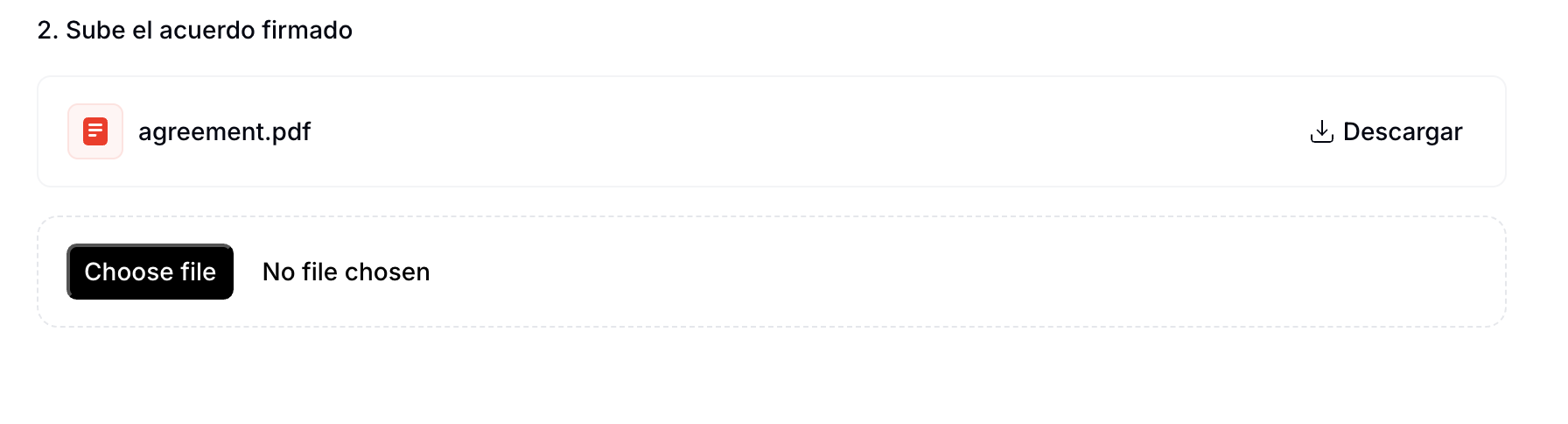
Overriding the previously submitted agreement
What is the minimum information required to register a supplier?
What is the minimum information required to register a supplier?
- Name
- NIF
- Address
- Full name
- Government ID type and number
- Address
What methods are available to sign the PDF supplier agreements?
What methods are available to sign the PDF supplier agreements?
What is the file size limit for the documents provided in the supplier registration flow?
What is the file size limit for the documents provided in the supplier registration flow?
How do I register a supplier with VERI*FACTU?
How do I register a supplier with VERI*FACTU?
 1
1🇪🇸 Invopop resources for Spain
🇪🇸 Invopop resources for Spain